Astroscale U.S. to Study Serviceability for NASA’s Habitable Worlds Observatory
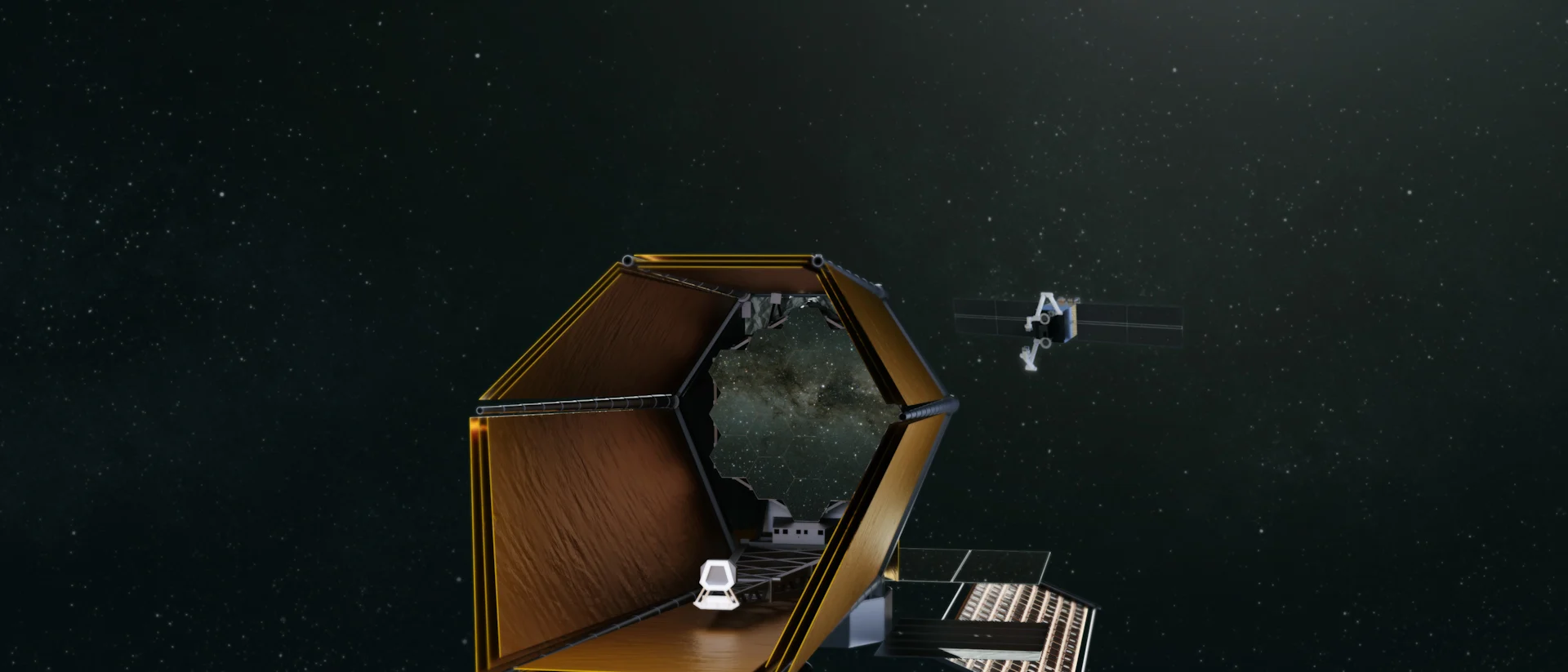
Pictured: Artist's concept of Habitable Worlds Observatory and servicer for illustrative purposes. Courtesy NASA and Astroscale U.S.
The study will explore how on-orbit servicing can help extend mission life and reduce risk for the groundbreaking telescope
DENVER, January 7, 2026 – Astroscale U.S., a leading provider of on-orbit services and logistics across all orbits, has been awarded a study by NASA to explore how serviceability can enhance the scientific returns and operational lifetime of the Habitable Worlds Observatory (HWO) mission concept.
HWO will be the first telescope designed specifically to search for signs of life on planets orbiting other stars. For the first time, NASA is considering the service architecture along with the mission architecture, ensuring the corresponding service requirements make their way into the final design and keeping operations going for generations. The Astroscale U.S. study will explore incorporating its pioneering on-orbit servicing capabilities to:
· Reduce program risk.
· Enhance scientific return.
· Optimize resource utilization.
· Minimize observatory downtime.
· Maximize maintenance and upgrade opportunities.
“The Habitable Worlds Observatory is a generational asset for all humankind,” said Dr. Clare Martin, Astroscale U.S. Executive Vice President. “By planning for long-term maintenance, repairs, and upgrades, NASA can maximize investment in science and discovery for some of humanity’s biggest questions. We are thrilled to be part of that effort.”
Planning for innovative robotic servicing of HWO follows the successful example of the Hubble Space Telescope, which utilized human servicing capabilities to maximize the telescope’s scientific value, allowing it to continue to provide valuable images and data or decades.
By leveraging mission heritage and dedicated expertise, Astroscale U.S. will develop protocols and service architectures for the unique needs of HWO, such as protecting sensitive instruments, component replacement, and refurbishment during operations.
The study will last for three years and will assess various servicing location strategies, comparing the technical and operational implications of conducting servicing operations at Earth’s second Lagrange Point (L2) vs. in cis-lunar space. The Astroscale U.S. study will also identify where NASA can work with commercial partners to explore how servicing can help NASA deliver the scientific benefits of HWO to the U.S. taxpayer and extend those benefits through maintenance and upgrade opportunities.
Astroscale U.S. is uniquely positioned to deliver innovative, practical insights that address HWO's servicing objectives while maximizing program value for NASA and the scientific community. As on-orbit servicing has advanced rapidly in the last decade, this study illustrates the intrinsic value a mature servicing architecture can bring to the science returns of the observatory.
END
About Astroscale U.S.
Astroscale U.S. Inc., is a leading provider of on-orbit servicing solutions and capabilities — including inspection, transportation, life extension, debris removal, and refueling — for the U.S. government and commercial operators around the world. Headquartered in Denver, Colorado, Astroscale U.S. applies world-class mission design and rendezvous, proximity operations, and docking capabilities to solve the complex challenges our customers face. Astroscale U.S. is dedicated to Astroscale’s vision of ensuring the secure and sustainable development of space for future generations.
For more about Astroscale U.S., visit astroscale-us.com.
For more about Astroscale, visit astroscale.com.