The Logistical Framework for the Golden Dome for America

The success of the Golden Dome for America will depend on more than advanced missile warning satellites and interceptors. It will require a resilient space logistics architecture capable of sustaining, maneuvering, servicing, repairing, and rapidly reconstituting critical space assets throughout prolonged operations. Space is now a contested warfighting domain, and logistics—not just technology—will determine whether the architecture can endure during conflict.
The United States possesses many of the technologies needed to support the Golden Dome for America through on-orbit servicing, autonomous rendezvous, robotic inspection, refueling, and responsive launch. But its success also requires an integrated military space logistics enterprise built around people, organizations, doctrine, acquisition, infrastructure, and operational capabilities.
The evolution of U.S. air superiority provides a useful model. Just as aerial refueling fundamentally transformed air power by extending reach, persistence, and operational flexibility, space logistics will provide the foundation for sustained and adaptable military space operations. To ensure the long-term resilience of the Golden Dome for America, U.S. space leaders should prioritize six strategic initiatives that will create a sustainable military space logistics enterprise:
1. Build a Dedicated Space Logistics Enterprise
A dedicated logistics enterprise would provide the institutional backbone needed to sustain the Golden Dome architecture throughout peacetime competition and wartime operations.
Key actions:
Create a flag-level organization responsible for space logistics strategy
Establish a dedicated U.S. Space Force career field for logistics and sustainment
Develop operational concepts, requirements, acquisition strategies, and long-term planning
Consolidate logistics expertise under a single enterprise to improve continuity and accountability
2. Design Spacecraft for Servicing
Satellites supporting the Golden Dome should be designed for inspection, refueling, repair, and modernization. Serviceable spacecraft reduce lifecycle costs while improving resilience against failures and adversary actions.
Key actions:
Standardize docking interfaces
Incorporate refueling ports
Include servicing accommodations
Adopt modular spacecraft architecture
Promote interoperability across national security space programs
3. Stand Up an Operational Servicing Fleet
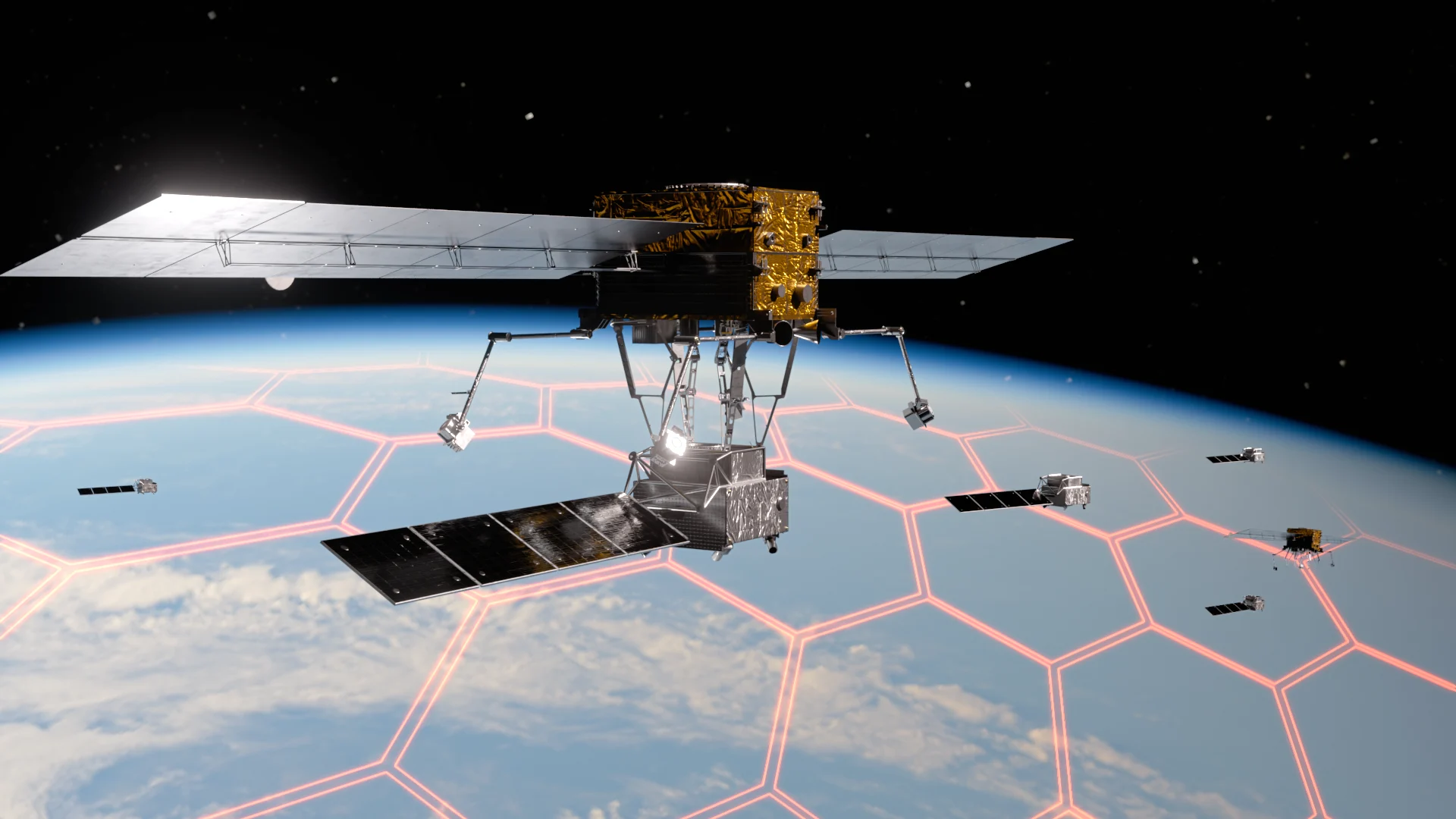
An operational servicing fleet would function as the maintenance and recovery force for the Golden Dome architecture, extending satellite lifetimes, restoring capability, and reducing dependence on replacement launches.
Key actions:
Field robotic refueling vehicles
Deploy life-extension spacecraft
Expand inspection and surveillance capabilities
Provide maneuver support
Establish emergency response capabilities for high-priority missions
4. Implement the Orbital Logistics Network
The Golden Dome will ultimately require orbital fuel depots, logistics nodes, and distributed infrastructure capable of supporting persistent military operations across multiple orbital regimes.
Key actions:
Develop fuel depots
Establish propellant reservoirs
Deploy modular storage platforms
Build distributed logistics nodes
Pre-position resources across multiple orbital regimes
5. Integrate Responsive Launch with Space Logistics
Responsive launch becomes even more valuable when integrated with servicing capabilities, enabling the Golden Dome architecture to rapidly replace, reinforce, or augment critical space assets during conflict.
Key actions:
Rapidly augment critical constellations
Replace degraded or lost spacecraft
Support changing mission requirements
Integrate launch and servicing into a unified logistics architecture
6. Protect the Logistics Infrastructure
The logistics infrastructure supporting the Golden Dome may become a high-value target during conflict. Protecting servicing vehicles, fuel depots, and logistics nodes is therefore essential to maintaining operational endurance.
Key actions:
Enable autonomous operations
Preserve maneuverability
Increase survivability
Develop defensive operating concepts
Operate effectively in contested space environments
The Time to Build a Space Logistics Enterprise Is Now
The Golden Dome for America represents one of the most ambitious national security space architectures ever envisioned. Its long-term success will depend not only on the satellites and sensors deployed today, but on the ability to sustain, service, repair, refuel, and rapidly adapt those systems throughout their operational lives.
Space logistics is the operational backbone that transforms a collection of satellites into a resilient military enterprise capable of enduring conflict. By investing today in servicing-ready spacecraft, orbital infrastructure, responsive launch, and a dedicated logistics organization, the United States can ensure the Golden Dome for America remains resilient, adaptable, and capable of maintaining space superiority for decades to come.